


Evaluating the Impacts of Mobi’s Equity Program on Access and Use of Public Bike Share in Vancouver
VANCOUVER PUBLIC BIKE SHARE
In 2016, the City of Vancouver launched its public bike share (PBS) system, Mobi by Rogers (Mobi), to provide people with a convenient, flexible, and affordable mode of transportation for their daily trips. From 2013-2018, the City of Vancouver and SFU’s CHATR Lab partnered to evaluate the uptake of the PBS program and its impacts on cycling in the city.
Since this time, the City of Vancouver and Mobi have implemented numerous changes to reduce barriers, enhance uptake, and make the PBS system more equitable. Specific changes include:
- An expansion of the service area to a more demographically diverse range of neighbourhoods.
- Adding e-bikes to the fleet.
- Reducing financial barriers through a Community Pass program.
- Partnering with community organizations to reach more diverse populations.
- Hiring an equity coordinator.
STUDY GOALS AND OBJECTIVES
The City of Vancouver approached Mobilizing Justice, a multisector partnership addressing transportation inequities in Canadian cities, to evaluate the extent to which these initiatives have resulted in more equitable uptake of PBS in Vancouver. With funding from the Mobilizing Justice Innovative Pilots & Policies, our research team evaluated how the equity initiatives have independently and in combination impacted a) usage and b) access to opportunities, for all members, and in particular for members who face transportation-related challenges. Our specific objectives were to:
- Determine whether the new stations added to this expansion resulted in a more equitable distribution of stations across neighbourhoods.
- Characterize bike share members and their use of the bike share system, with a focus on Community Pass members and e-bike usage.
- Explore the benefits, facilitators, and barriers to the success of the Community Pass program for both Mobi’s community partners and pass users.
We employed three methods to explore these objectives: socio-spatial analyses, analyses of system and online survey data, and interviews with community organizations that provide referrals to the Community Pass program.
1) SOCIO-SPATIAL ANALYSES
Equity Initiative
Between 2018 and 2022, 132 PBS docking stations were added for a total of 241 permanent stations, doubling the geographical size of the initial service area (Figure 1) and increasing the proportion of the Vancouver population with access to bike share from about a third of the population (34.2%) to over half (51.9%). Our analyses evaluated whether the new stations added since 2018 has resulted in an equitable distribution of stations across neighbourhoods.
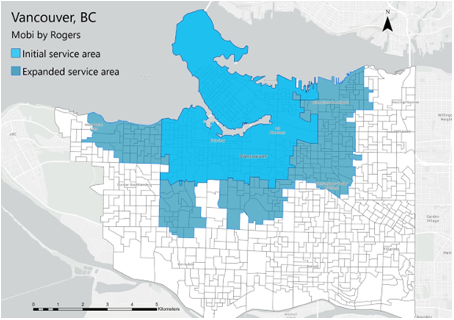
Figure 1. The initial (2016-2017) and expanded (2018-2022) service area of Mobi by Rogers in the City of Vancouver, Canada.
Key Findings
The service area expansion reduced inequities in spatial access by area-level socioeconomic status, but access remained lower in areas with lower socioeconomic status, with these areas receiving the smallest share of the expansion. The proportion of neighbourhoods inside the service area with lower area-level socioeconomic status increased from 3.1% (2017) to 12.9% (2022). While this showed progress towards reducing inequities, parts of the city with higher area-level socioeconomic status continued to be better served by bike share overall, accounting for two-thirds (66.7%) of all city areas located within the service area.
For other priority populations, we found that area-level inequities in access either stayed the same or improved. We observed that areas with higher proportions of priority populations, in general, were less likely to be in the service area. Particularly, areas with higher proportions of racialized populations still have poorer spatial access to PBS. The largest increase in access for city areas with the highest proportion of priority population were for children, Indigenous residents, and Indigenous women, respectively. There was no change in access by area-level immigrant status over time.

See the full report here
2) SURVEY
Equity Initiative
E-bikes were added to Mobi’s fleet in the summer of 2022, and by December 2022 they comprised nearly 1 in 5 of the system’s 2,527 bikes. Given Vancouver’s hilly topography, e-bikes have the potential to attract more riders, including those with mobility limitations.
The Community Pass program was introduced in 2018. The pass reduces financial barriers to bike share by providing a discounted membership, cash payment options, and reduced liability for bikes that are lost, stolen, or damaged. Members become eligible by providing proof of enrollment in other subsidized programs, proof of an annual income less than $27,000, Persons with Disabilities (PWD) designation, or referrals from a community partner. Members who qualify for the program with a PWD designation can use e-bikes without an additional charge for the first 60 minutes of their trip.
Key Findings
The Community Pass has made gains towards transport equity by extending bike share membership to more diverse segments of the population and increasing access to different types of destinations. The addition of e-bikes is benefitting Community Pass members who qualify through a PWD designation as the majority of their trips were made by e-bike. However, regular Community Pass members were far less likely to have tried or regularly use e-bikes.
The Community Pass is reaching more diverse populations, in particular people with lower incomes, racialized populations, and people with a disability. Compared to the Vancouver population, older adults, women, people with lower household incomes, racialized populations are less likely to have an annual or monthly PBS membership. Members with standard passes were more likely to be between the ages of 35-64 years, be men, have an annual household income greater than $100,000, and be white, relative to the Vancouver population.
E-bikes are more readily adopted by standard pass and Community Pass members who qualify through a PWD designation. Around 1 in 3 (29.4%) standard pass members and 1 in 4 (26.5%) Community Pass members had used an e-bike at least once. Of those members who had tried the e-bikes, Community Pass members were more frequent users of e-bikes than standard pass members, with a higher proportion of all trips being made on e-bike (14.3% of all trips compared to 10.1% for standard pass members) and more frequent trip rate (mean of 10.5 trips per month compared to 3.8 trips per month for standard pass users).
See the full report here
3) Community Organization Interviews
Equity Initiative
Mobi hired a full-time equity coordinator in 2018 to help coordinate and manage the various equity initiatives, including the Community Pass program. Mobi has developed partnerships with local non-profit and government agencies to expand the reach of this program. Community partners play a key role in referring members to the Community Pass program, with about 60% of applicants for the pass coming from a partner referral.
Key Findings
Of the 15 organizations that were invited to participate, we spoke directly with six of Mobi’s community partners that serve demographically diverse populations, including:
- Children, youth, and families living on low incomes
- People experiencing homelessness, poverty, and substance use
- Binners (individuals collecting refundable materials for income)
- People in transitional employment programs
Benefits
The Community Pass program improves access to various social and economic opportunities and resources, such as education and employment, practicing autonomy and life skills for youth and adults, and socializing with friends and family.
The Community Pass program enables people to promote their own health through recreation, fitness, and active living.
The Community Pass program enables people to use a mode of transportation that aligns with sustainability commitments of community members and the organizations that serve them.
The Community Pass program supports an equitable approach to active transportation by facilitating a low-cost entry into cycling for equity-deserving populations and aligning with the goals of the community organizations that serve them.
Facilitators & Barriers for the Community Pass
The low-barrier sign-up process and ongoing support for pass registration are facilitators to using and accessing the Community Pass program, however digital access and literacy are barriers for some members.
Physical infrastructure, such as the location of docking stations, is both a facilitator and barrier to using and accessing the Community Pass program, while the city’s network of bike lanes is a facilitator.
Cycling enthusiasts who champion cycling and PBS are facilitators to using and accessing the Community Pass program.
Knowledge gaps about PBS and the program are barriers to using and accessing the Community Pass program.
Organizational capacity and resources are barriers to referring more members to the Community Pass program despite partner enthusiasm about the program.

See the full report here
KEY LEARNINGS ACROSS OBJECTIVES
Equity initiatives implemented are enhancing transport equity by:
- Reducing inequities in spatial access.
- Extending bike share memberships to more diverse segments of the population.
- Increasing access to opportunities for equity-deserving populations.
Despite these gains, continued efforts are needed as lower income and more racially diverse populations continue to have worse spatial access and lower adoption of public bike share.
Opportunities to build on existing efforts:
- Offering in-person sign up sessions for the Community Pass in neighbourhoods where equity-deserving populations live.
- Installing docking stations in neighbourhoods where equity-deserving populations live, while recognizing that the successful uptake of PBS and the Community Pass program also relies on the quality of the area’s existing cycling infrastructure.
- Continuing collaborations with community organizations to promote the Community Pass program and integrate it into existing programming, such as rehabilitation programs to promote active recovery.
- Expanding the promotion of the Community Pass program, including the PWD Ebike Pass option, to reach a more diverse range of PWD across the city.

Summary poster of “Evaluating the Impacts of Mobi’s Equity Program on Access and Use of Public Bike Share in Vancouver”.
PARTNERS
- Cail Smith, City of Vancouver
- Robert Pennings, City of Vancouver
- Matej Mecar, City of Vancouver
- Taylor MacVittie, Mobi by Rogers
- Mia Kohout, Mobi by Rogers
- Meghan Winters, Simon Fraser University
- Kate Hosford, Simon Fraser University
- Christine Yanagawa, Simon Fraser University
- Madi Lore, University of British Columbia

 Cities, Health, and Active Transportation Research