
Bicycle Parking Research and Resources
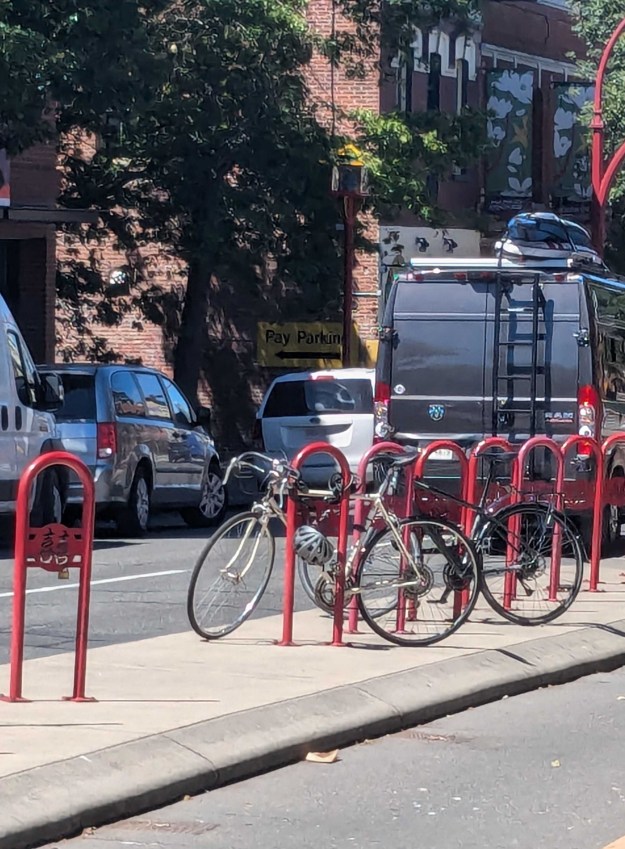
CHATR Lab has been working on better understanding bicycle parking, particularly its integration with transit.
Access to major transit hubs or stations is often met by feeder buses that may be crowded and infrequent. Cycling is gaining interest as a more flexible and convenient mode to bridge this “first and last mile” gap. In addition to connected and comfortable cycling infrastructure, successfully integrating cycling with transit is further supported by having secure bicycle parking at stations.
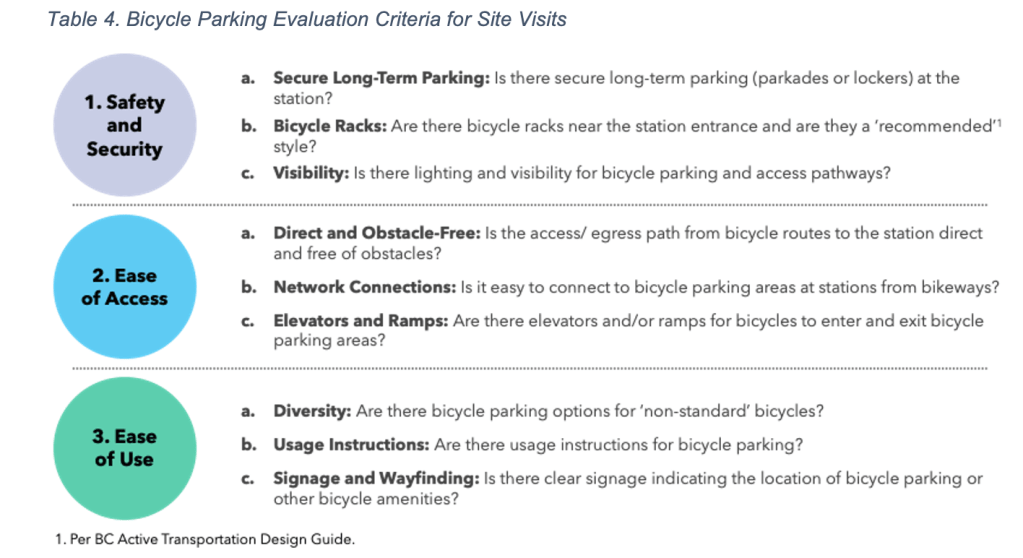
In her thesis, Exploring Bicycle-Transit Integration and Cycling Accessibility to Rail Rapid Transit in Metro Vancouver, Helena Lin (MUrb) unpacks how well integrated the Expo Line is for access by bike. Her thesis assessed integration through spatial access measures, bicycle parking infrastructure, and policy considerations. Table 4 from her thesis lists the criteria she used to evaluate bicycle parking facilities.
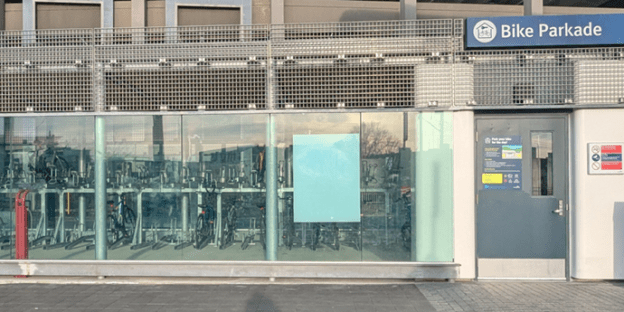
Like other bike facilities, bicycle parking needs to accommodate a range of bicycle types (e.g., cargo bikes, e-bikes) – currently, many bike racks are only suitable for conventional bikes. Signage, wayfinding, and information about bike parking facilities is a gap across the network. These are a key aspect of access and usability.
ADDITIONAL KNOWLEDGE OUTPUTS
Our research partners at CapaCITY/É hosted a webinar on Bike Valets. In this presentation, Rebecca Uhland of Capital Bikes shares lessons learned from growing their event-based bicycle valet services and details how they operate the City of Victoria’s permanent downtown bicycle valet.
The availability and quality of bicycle parking is key to encouraging cycling as a transportation mode. Bicycle parking varies in style, serving different contexts and purpose. How do we classify what we currently have and what is needed?
- In 2024, we created Can-PARK – a high-level framework to support classification of different bicycle parking facilities. Can-PARK is based on a review of practice guidelines and grey and academic literature with the intent to inform funding decisions for bicycle parking and support research in Canada. To evaluate the utility of a bicycle parking facility, i) fit-for-purpose; ii) functional considerations; and iii) integration with public transit should be considered. Fit-for-purpose is often categorized by duration of use: long-term, short-term, and temporary. Within each of these categories, capacity, shelter, and security are additional characteristics that differentiate various types of bicycle parking. This work was funded by Infrastructure Canada. (Version française ici.)
- As a follow-up, in 2025 we examined the feasibility of creating a dataset of bicycle parking around transit stations, using nine Canadian cities as case studies and OpenStreetMap (OSM) as a consistent dataset. We found that bicycle parking on OSM is currently too inconsistent in its completeness and classification to develop an accurate national dataset. However, improving OSM bicycle parking data around transit stations may only be a matter of targeted outreach and communication to local governments and transit agencies. This work was funded by Housing, Infrastructure and Communities Canada.
PARTNERS
Support: Housing, Infrastructure and Communities Canada (formerly Infrastructure Canada).
 Cities, Health, and Active Transportation Research